

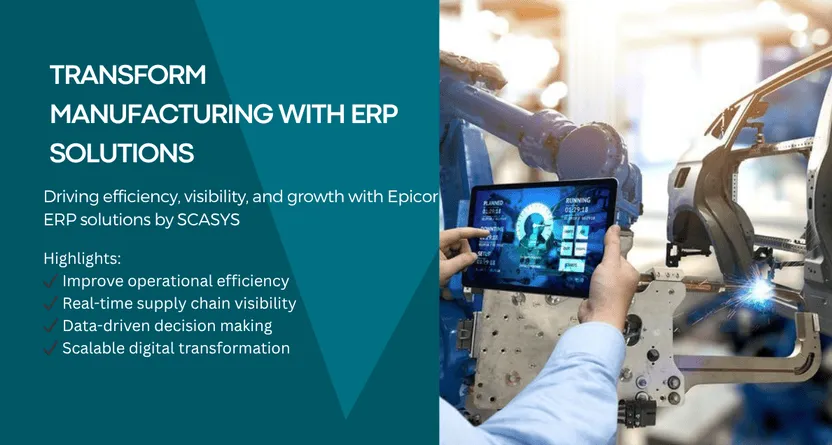


As manufacturing businesses continue to grow and innovate, the systems supporting them must evolve as well. At the center of these systems is Enterprise Resource Planning (ERP), the digital backbone that connects people, processes, and data across an organization.
Modern manufacturers face several challenges, including global competition, complex supply chains, and increasing customer expectations. In many organizations, disconnected systems create data silos that slow decision-making and limit efficiency. To stay competitive, manufacturers need technology that enables them to adapt quickly to changing business strategies and market demands. ERP systems play a crucial role in enabling this transformation.
ERP integrates multiple business functions into a single platform. From finance and procurement to production planning and customer management, ERP systems connect key operations across the organization.
By replacing disconnected tools with a unified system, ERP improves visibility and ensures teams have access to accurate, real-time information. This allows manufacturers to track the entire product lifecycle—from design and production to delivery and after-sales service.
One of the biggest benefits of ERP in manufacturing is improved operational efficiency. ERP systems automate workflows, reduce manual processes, and improve coordination between departments.
With ERP, manufacturers can:
These capabilities help organizations improve productivity and respond quickly to changing market demands.
Many manufacturers today operate using multiple production models. These may include Make-to-Stock (MTS), Make-to-Order (MTO), Engineer-to-Order (ETO), or Configure-to-Order (CTO).
Modern ERP systems are designed to support these diverse manufacturing approaches within a single platform. This flexibility allows businesses to adjust production strategies while maintaining full control over operations.
Managing supply chains has become increasingly complex. ERP systems help manufacturers improve supply chain visibility by integrating procurement, inventory management, and logistics.
With real-time insights into supply and demand, organizations can identify potential disruptions early, improve supplier coordination, and ensure timely product delivery.
ERP systems collect and centralize data from across the organization. With built-in analytics and reporting tools, manufacturers can monitor key performance metrics such as production efficiency, operational costs, and inventory performance.
These insights help leaders make informed decisions that improve profitability and operational performance.
As manufacturers adopt new technologies such as automation, analytics, and connected devices, ERP platforms provide the foundation that connects these systems together.
Modern ERP solutions offer cloud capabilities, mobile access, and integration tools that support digital transformation while enabling businesses to scale as they grow.
ERP has become an essential technology for modern manufacturing operations. By integrating business processes, improving operational visibility, and enabling data-driven decision-making, ERP systems help manufacturers operate more efficiently and remain competitive.
Organizations that invest in modern ERP solutions are better positioned to streamline operations, strengthen supply chains, and drive long-term growth in an increasingly dynamic manufacturing environment.


.jpg)

.jpg)
.jpg)
.jpg)