
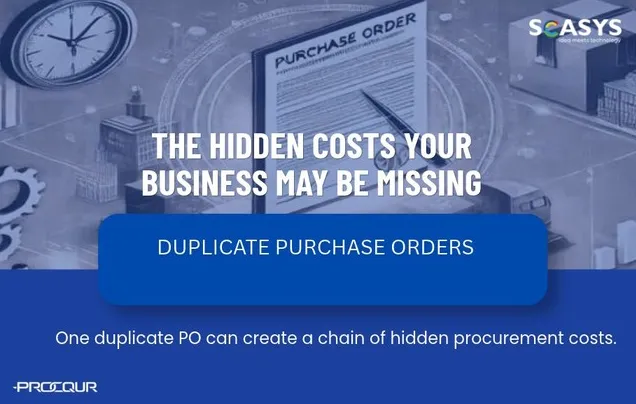


Duplicate purchase orders are often treated as a minor administrative mistake. A buyer may accidentally raise the same PO twice; a department may not know that another team has already placed an order, or an urgent requirement may result in a second PO before the first one is checked.
But the impact can extend far beyond ordering the same item twice.
In businesses managing multiple suppliers, locations, departments, and purchasing workflows, duplicate POs can quietly affect procurement efficiency, data accuracy, budgeting, supplier coordination and operational planning.
When two POs appear to cover the same requirement, procurement teams have to investigate.
Was the first PO cancelled? Is the second one intentional? Has the supplier processed either order?
Instead of focusing on sourcing, negotiations and supplier management, employees spend time comparing emails, approvals, PO histories, and supplier confirmations.
The hidden cost is the time spent resolving a problem that should have been prevented.
Purchase data supports supplier analysis, spend reporting, and procurement decisions.
Duplicate cancelled and reissued POs can make this data harder to interpret. A supplier may appear to have received more orders than necessary, while purchase volumes may look higher because several transactions relate to the same requirement.
When procurement data is inconsistent, management may find it harder to identify genuine purchasing trends.
A purchase order can act as a demand signal for other business functions.
Procurement information may influence:
Material planning → Inventory forecasting → Production scheduling
If duplicate POs are included in these processes, the organization may appear to require more materials than it does.
That can create unnecessary complexity in planning and forecasting.
Duplicate POs can also affect budget visibility.
For example, if a department raises two POs for the same ₹3 lakh requirement, both may temporarily appear as commitments against the available budget.
Even when one is eventually cancelled, managers may have difficulty understanding the organization's actual purchasing commitments without checking the transaction history.
The problem becomes more significant when organizations operate across multiple plants, warehouses, branches, or business units.
One location may raise a PO without knowing that another location has already purchased the same material or has an open PO with the supplier.
Without consolidated visibility, businesses can miss opportunities to coordinate purchasing and understand their total requirements.
Duplicate POs can create unnecessary back-and-forth with suppliers.
Suppliers may need clarification about:
Repeated corrections can consume time on both sides and complicate order coordination.
Procurement teams often monitor metrics such as PO processing time, purchasing volume, and supplier fulfilment.
Duplicate and replacement of POs can distort these measurements.
A cancelled PO followed by a replacement may appear as multiple transactions. This makes it harder to distinguish genuine procurement delays from administrative corrections.
The solution is not simply to identify duplicate orders after they are created.
Businesses need better visibility before a PO is submitted.
An integrated ERP and procurement system can help teams view existing purchase requests, open POs, supplier history, quantities, approval status, and purchasing activity in one workflow.
Controls such as duplicate detection, approval of workflows, open-PO tracking, budget monitoring, and cross-location visibility can reduce the possibility of unnecessary purchase orders reaching suppliers.
A duplicate PO may look like a small administrative error.
But repeated duplication can create hidden costs through wasted employee time, unreliable procurement data, distorted demand signals, unclear budget commitments and unnecessary supplier communication.
The bigger question is not simply:
“Did we create a duplicate PO?”
It is:
“Can our procurement system identify a potential duplicate before it becomes a problem?”
With connected ERP and procurement processes, businesses can move from correcting purchasing errors to preventing them.