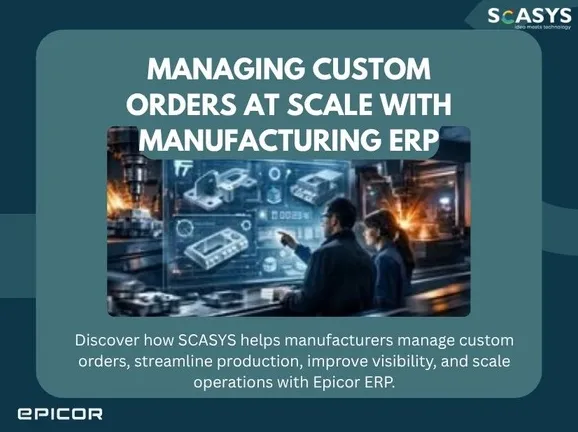



Manufacturing has become more complex than ever. Multiple production lines, changing customer requirements, subcontracting, engineering changes, quality checks, inventory movements, and tighter delivery commitments all need to work together.
Yet many manufacturers continue using ERP systems that were designed for a much simpler operating environment.
The real question is not whether your ERP is old. It is whether it can keep up with the way your manufacturing business operates today.
For manufacturers across India and South India, this becomes increasingly important as businesses expand production capacity, manage multiple locations and serve increasingly demanding customers.
When production planners constantly switch between ERP screens and spreadsheets to determine what needs to be produced, when it should be produced and whether materials are available, the ERP is no longer the central planning system.
A change made in one spreadsheet may not reach purchasing or production teams on time.
A capable manufacturing ERP should connect demand, materials, capacity and production schedules, giving planners a more reliable view for decision-making.
Product specifications change. Components are replaced. Bills of materials are revised. Customers request modifications.
The challenge is making sure the correct revision reaches every department involved in production.
When engineering changes are communicated through emails or manual instructions, outdated information can reach the shop floor.
ERP should help connect engineering changes with the operational processes they affect, reducing the gap between what was designed and what gets manufactured.
An ERP may show that material is available, but is it actually ready for production?
It could be allocated to another order, waiting for inspection, located in another warehouse, under subcontracting, or still in transit.
Manufacturers need visibility into quantity, location, status and allocation—not simply a stock number on a screen.
The gap between the shop floor and ERP can become a significant source of inefficiency.
Operators may manually record production quantities, labour time, scrap or downtime and enter the information later.
This creates a gap between what happened and when management knows about it.
Connected shop-floor data can help teams identify production issues sooner and respond before they affect schedules and customer commitments.
Many manufacturers outsource processes such as machining, coating, heat treatment, fabrication, or assembly.
Materials leave the facility, processing happens externally, and goods return for the next stage.
If these activities are tracked separately from the main production process, visibility into material movements, progress, and costs can quickly become fragmented.
Your ERP should provide better control across the entire outsourced production cycle.
An ERP that worked well when a company had one plant, fewer products and a smaller supplier network may struggle as the business expands.
More locations mean more inventory points.
More products mean more planning complexity.
More suppliers mean more dependencies.
More customers mean more delivery commitments.
Growth should not require additional spreadsheets, manual workarounds, and disconnected applications simply to keep operations moving.
Your ERP should scale with your manufacturing complexity.
The question is not simply:
“Do we have an ERP?”
It is:
“Can our ERP support the complexity of our manufacturing operation?”
A modern manufacturing ERP should help connect:
Planning → Procurement → Materials → Production → Quality → Inventory → Finance → Delivery
When these processes work with connected information, manufacturers can improve visibility, reduce manual coordination, and respond faster to operational changes.
For manufacturing businesses across India and South India, this connected approach can support organizations as they scale operations while managing cost, quality and delivery expectations.
If your teams are constantly maintaining spreadsheets, reconciling reports, manually tracking production, or creating workarounds, your ERP may no longer be aligned with your manufacturing needs.
At SCASYS, we help manufacturing organizations modernize their ERP environment with connected business processes, operational visibility, and scalable digital transformation.
Because an ERP should do more than record what happened.
It should help your business understand what is happening, what needs attention, and what should happen next.