
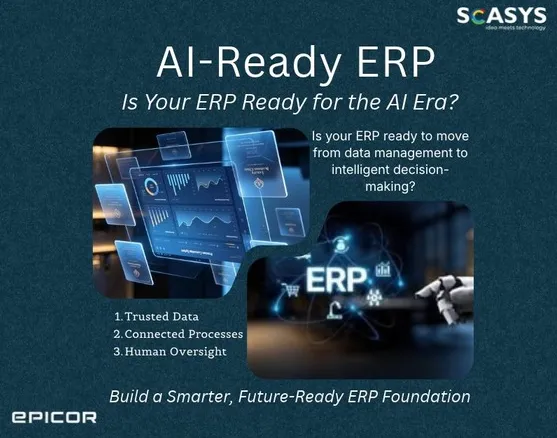


Artificial intelligence is changing how businesses use enterprise software. But simply adding an AI tool to an existing ERP system does not make an organization AI-ready.
For manufacturers, distributors, and growing enterprises across India, South India, the UAE, and the GCC, the more important question is whether the ERP can provide the data, business context, connected processes, and controls that AI needs to deliver meaningful results.
AI is only as effective as the business environment supports it.
AI depends on reliable information. Inconsistent master data, duplicate records, outdated supplier details, or incomplete transaction histories can affect the quality of AI-generated insights.
Before introducing AI, businesses should examine:
A strong ERP data foundation gives AI better information to work with.
AI becomes more useful when it can understand relationships between different areas of the business.
For example, a purchasing decision may depend on inventory levels, production requirements, supplier performance, open purchase orders, and customer demand.
When this information is spread across disconnected systems or spreadsheets, AI only sees part of the picture.
An AI-ready ERP environment should connect finance, procurement, manufacturing, inventory, sales, and supply chain data so that AI can work with a broader operational context.
Traditional ERP reporting primarily answers: What happened?
AI can help businesses explore: Why did it happen, and what needs attention?
Instead of simply showing increased material consumption, an intelligent ERP environment could help users investigate potential relationships with production changes, purchasing patterns, inventory movements, or demand fluctuations.
This represents a shift from report consumption to contextual intelligence.
AI cannot automatically fix an inconsistent business process.
If different departments follow different approval routes, maintain separate supplier information, or handle the same task differently, AI may only add another layer of complexity.
Businesses should first identify:
Once these processes are clearly defined, organizations can determine where AI can provide meaningful assistance.
Generic AI can provide general answers. Enterprise AI needs to understand the organization's actual business environment.
An ERP contains information about products, customers, suppliers, orders, costs, production, inventory, and financial transactions.
Connecting AI with this business context can make its outputs more relevant to real operational situations.
The objective is not simply to have an AI assistant, but to have one that can work within the organization's ERP environment and business processes.
AI readiness does not mean removing people from important decisions.
For procurement, finance, production planning, pricing, and supplier management, AI can identify an issue or recommend an action while employees retain final approval.
A practical model is:
AI identifies → AI recommends → Human validates → ERP executes
The level of human oversight can vary depending on the process, risk, and business requirements.
As AI gains access to ERP information, businesses also need to consider how that information is protected.
Organizations should establish appropriate controls around:
AI should operate within clearly defined business boundaries rather than having unrestricted access to enterprise information.
AI adoption rarely happens at once. A business may begin with procurement analysis, inventory insights, financial assistance, or production planning and later expand into other areas.
Therefore, ERP readiness should be viewed as a long-term capability.
The goal is not to add AI everywhere. It is to create an ERP environment where new intelligent capabilities can be introduced as business needs to evolve.
AI readiness is about more than having an AI feature inside your ERP.
It requires trusted data, connected processes, business context, security, governance, and the right balance between AI assistance and human decision-making.
Before investing in another AI tool, businesses should ask:
Is our ERP data reliable? Are our processes connected? Can AI access the right business context? Do we have appropriate controls? Can our ERP evolve with future AI use cases?
If the answer is yes, your ERP has a stronger foundation for the AI era.
If not, the AI journey may need to begin with strengthening the ERP foundation itself.
SCASYS helps businesses modernize ERP environments and explore intelligent solutions that support connected, data-driven, and future-ready business operations.